Thursday, 1 May 2014

Tour de France Sequence of Lessons


Follow and celebrate the Tour de France 2014 as it travels from Yorkshire through England and across to France 
and around ,up and down and through the country! 


This afternoon we having been discussing the tour de France! Here are a sequence of lessons that I have helped to create based on the resources you can find here tour de France links and resources


Below are some ideas for us firstly to use in all target languages: 

A virtual tour of the Tour de France !
A virtual tour from Yorkshire to the finishing line in Paris
Let’s create our own virtual 3D tour and add our own 2D and 3D famous buildings from cities on the way  to the finishing line . Create a 3D tour Eiffel for the finishing line!

Here's a video clip to help us achieve this 


And follow this link to find 
3D tour Eiffel   
to complete your 
own virtual 3D class tour 


Physical Grammar Game !

The class need to decide on three symbols to represent nouns, adjectives and verbs. Stand up right for a noun, wiggle your body for an adjective and pump your arms for a verb ( just like you would have symbols in Charades for book, film, musical etc.

Divide your class into “Tour de France t-shirt teams- different coloured t-shirts . No team should be le maillot jaune/la camiseta amarilla or das gelbe Tshirt. This one is for the winners!

Let’s brainstorm nouns, adjectives and verbs that we associate with the tour de France. Can access these in the target language in bilingual dictionaries .
Here are some to start us off  ……….


Nouns

Cyclist , bike , wheel, tyre, puncture , race ,helmet , t-shirt , shorts ,road ,city ,start, finish ,speed, power….

Adjectives

,fast , fit ,tired, thirsty, determined , exciting, powerful , competitive ,breathless


Verbs

To push , to pedal ,to race ,to compete, to challenge , to cheer, to watch , to participate, to win , to lose , to pass , to crash, to celebrate


 A volunteer  from a team selects a word from a cycle bag and decides if it’s a noun, an adjective or a verb. They must mime this – one point for getting this correct and then they must mime the meaning of the word- one more point for the team if they can guess and say it in the target language. If you play this UKS2 Year 6 or with KS3 with there are two bonus points with UKS2 if they can put the noun or the adjective in to a simple sentence and can any of them create a first person singular present tense statement with a verb (e.g. I push , I pedal, I race etc )? Verbs would b e at the teacher’s discretion – depending on whether they are regular verbs or not in the first instance.


 Cyclists on tour- a language recall game!


You will need  dice ,different coloured  counters for the players and the board,which you can download here Simple tour de France and sports vocabulary game

It doesn't just need to be abut sports though ....read on!


Divide your class in to teams of four .How many times around the board can the children race before the end of a designated amount of time – on a countdown timer ? If they land on an odd number they have to pick up a picture card and say the word they see in the target language. If they land on an even number they have to ask a question of another person in the game. They cannot repeat the question that was said by the last player to land on an even number. The winner of the race will own the yellow jersey and will have been around the board the most times or got the farthest around the board before the end of the timed race!


Our own class jerseys!

Take a look here at the jerseys that are rewarded during the whole race  

Can the class design their own Tour de France jerseys – either on real plain white t-shirts or as card cut outs for a class mobile or display? Each of these t-shirts should have written on them the characteristics of a true sportsman in the target language – either as single words or as simple present tense sentences using the verb “to be”  

Superlative t-shirts

Take a look at how to form the superlative in the target language . a good activity again for Year 6 or KS3 .In your class which characteristics make the best members of the class …. The most organised, the most creative, the tidiest , the most helpful, the kindest. Now can your class help you to design reward t-shirts for the duration of the Tour de France?these can be awarded for the “superlative” people in your class during the Tour de France! Display the t-shirts with their superlative labels for all to see and add the faces of the children who win these t-shirts one by one.


Poster Power Poem Performances! 

Why not create your own Power Poem Performances using posters as stimulus for draft writing of poems which can be short such as a haiku made up of adjectives or verse by verse present tense sentences using a noun verb and adjective to describe elements of the Tour de France. The children  perform the poems and bring the posters to life!
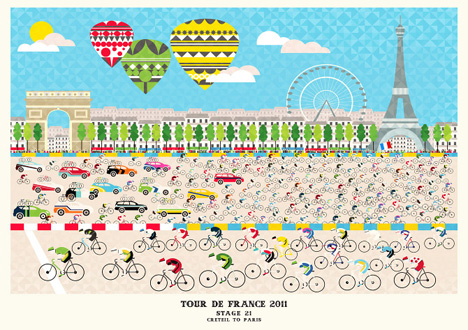
Here's the link to the blog post with the poster power poem lesson guide and below is a poster that inspired me!


And finally for French language learners ….


Food Fest

Let’s go on a Tour de France food fest and take in the regional foods. Let’s have a food-tasting journey and keep an E- journal of the foods we try – photos, sound file comments and short videos of foods we try or foods we find on line. Take a look at this article of 40 Tour de France  regional recipes 


Mon vélo est blanc

Let’s learn and perform this simple poem for a school assembly. Why not adapt the poem and change the colours.


Or take a break and watch with KS2 children le petit Nicolas le vélo


Tuesday, 29 April 2014

World Cup Warm Ups


 World Cup Warm Ups 
To get the children up , moving and participating!

All three power points in French, Spanish and German can be accessed here World Cup Warm up power points ....

The World Cup Warm up lesson or lessons are easy to deliver and link language learning with physical activity and even measuring pulse rates.There is even the opportunity to create a musical performance of the World Cup Warm Up song.
  • Revisit numbers
  • Practise simple commands 
  • Play simon says with the commands 

  • Share the ppt story with the class .
  • Give out the picture with out the captions
  • Can the class match the written caption to the correct picture 
  • Can the class perform the warm up .Check your pulse rates before and after the activity! 
  • Set up challenges where one group challenges another table to do an activity ten times

  • Now the children are ready in groups of four or six to create their own world cup warm ups- reordering the activities and changing the amount of times each activity should be done .
  • They could record themselves performing the routines and train a second group to carry out their routine.


  • Create a World Cup Warm Up class song to familiar sporting themes tune such as Match of the Day as your PE warm up for the Summer last half term using this language!


World Cup Lessons Ready to go !


We are getting ready for the World Cup in the Network
Celebrate the diversity of languages
Link language learning to sport and performance
Take a journey to meet children around the World
Find out more about target language countries, emblems and the footballers!


As part of our  support work in  the network we will be offering teachers the opportunity to celebrate the World Cup . Resources and ideas are located here World Cup in French , Spanish and German . Most of the lesson plans and our own JLN resources and ideas can be adapted to other languages too!


We have sourced online resources that can help you to create a bespoke sequence of lessons and have added links to World Cup resources such as 
on Lightbulb resources World Cup , where you will find lots of downloadable activities and resources that could enhance the lesson focuses below. 

How are we could we put these ideas and resources together in to a sequence of lessons with language learning at the hear of them?
Well as they say in football term "' 'ere we go, 'ere we go' ere we go!".....

Catch a greeting

Let's start by catching a greeting 

Take a look at the lesson plan here 

Create a football chant of our own
Take a look at the lesson plan
It's called A football chant of our own

Let's meet children from around the footballing world
Let's create target language conversations and get to know them
Take a look at the lesson plan
It's called Meeting children from the target language countries

Hold a flag bearers parade
Based on a primary languages and drama lesson
Take a look at the lesson plan
It's called Countries and flags of the World

Meet the footballers!
Find out about the teams on the Fifa website
Listen to and find out about the languages they speak
Create the personalities and characteristics of the footballers
Take look at the lesson Who is the person inside the player?


Participate in the world Cup Warm Ups!
Take a look at our simple 
World Cup Warm Up Lessons and PPTs 
Create routines with numbers and actions
Create a class warm up song for the Summer term PE lessons


Put your PE lessons into French, Spanish and German!
Warm ups, pass and shoot, dribbling, invasion sports activities !
Here are the World Cup Football Games 
Just find the correct file- French, German or Spanish
Hold a "Football Finale" or a World Cup performance
Why not teach the children ......


A Spanish Dragon Football poem
The Rock the Capitals  South American Countries  Rap
A Tunisian rhyme and song in French or Spanish

J'ai laissé mon ballon 
Mi pelota   


And now you have your sequence of World Cup lessons in the net!


Friday, 25 April 2014

Laying the foundations for future language learning

Laying the foundations for future language learning…… 

Our Show Tell and Share


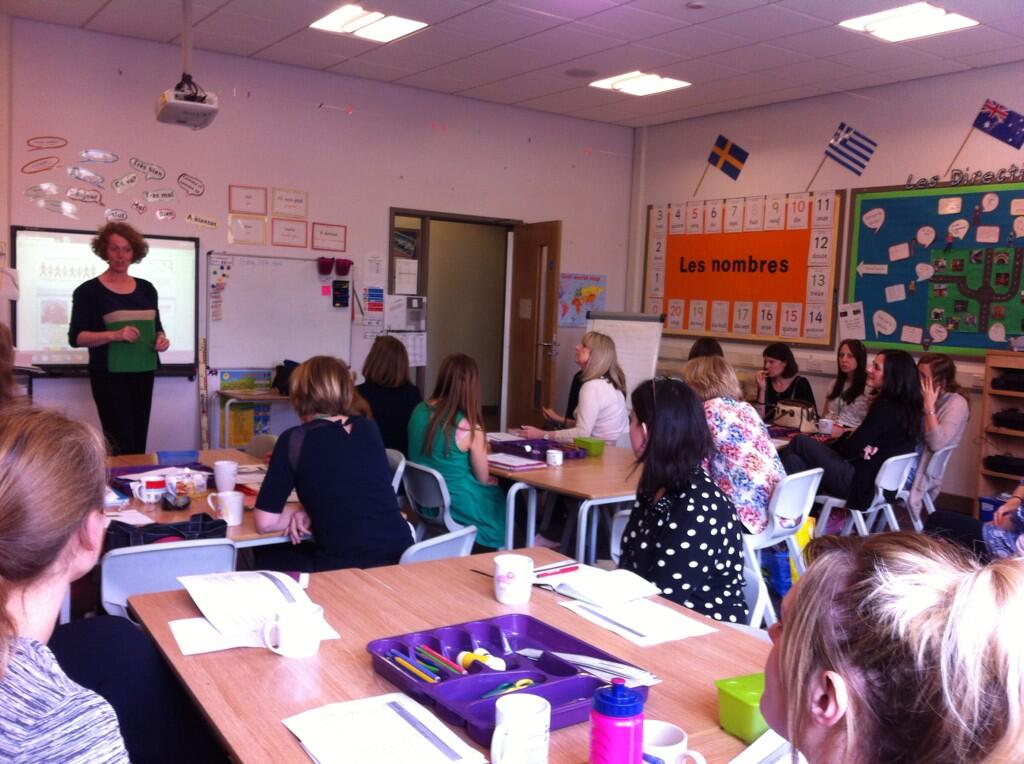
Yesterday we held our “Show tell and share” network meeting (24 April 2014) in Mandy’s language room at Stockton Heath Primary School, Warrington.


40 primary school colleagues attended the event .Eight colleagues had been invited to share  ideas, or a simple practical sequence of lessons in short 5-10- minute presentations.


It’s important to understand that the colleagues who were brave enough to show, tell and share are primary language practitioners who deliver languages in their own schools every week of the year- one Head teacher, three primary classroom teachers, three teaching assistants and a visiting teacher. 
They represent a cross section of  90 schools in the network and different stages of primary language progress (starting off, moving on and established practice). Most importantly the ideas were practical and replicable and teachers and teaching assistants in the audience  could take ideas for primary language learning back to their  own schools and try them out. 

Illness and monsters

Cathy, from Appleton Thorn CP shared all her creative ways of developing a unit on illness and parts of the body. She stressed the importance of sounds and recognition of the spoken word before showing children the written word. She explained how she feels that this is necessary  to enable all children to make the link smoothly between spoken and written language. Her focus on sounds and patterns and investigating the words helps her children to confidently use the words and find new language they want to say in dictionaries etc. Cathy encouraged us to ask children to look for cognates and near cognates and to link games and practical work with more creative art and design opportunities. 


In this sequence of activities Cathy was using work around fantastical creatures – Frankenstein type monsters to engage the children in learning parts of the body so that they could then develop role plays on familiar everyday matters – going to the doctors and explaining simple illnesses.


E Twinning Project with Spain

Ian from Cronton CE, one of our Knowsley schools, shared how the school had developed an ETwinning project with their new link school in Spain .The school already has an established link with a German school. 

The project was for Year 3 in their first year of Spanish and was based around learning simple weather phrases. Ian’s input was the language element and the coordination with the Spanish school. 


Every day of each week that the project was happening(Autumn 2013), the class TA worked with a different group of 4 children to record in Spanish the temperature, the weather and dressed in clothes appropriate to the weather to create a photo record . 

At the end of each week the group created the class weather report in Spanish plus photos via Pic Collage  and sent this by email to their Spanish school. 

The mail exchange of the Pic Collage reports raised all sorts of interesting points for example what were the Spanish  children doing roasting chestnuts in the playground for a chestnut festival instead of an ordinary school day! Ian’s project show how we are opening the door on new cultures and laying foundations and  interest in  purposeful practical future language learning 


The verb être

Sam from St Philips CE got us thinking about how easily we can integrate work around verbs into our everyday language learning in the primary classroom. She has just run a focus on the verb être  as part of the Y6 children’s work on “Who am I? We loved the video clip she sourced and used  and the simplified rap song she created with the children from the French language in this clip


The children created spider grams of the verbs for example using a sunshine and the beams off a sunshine to show the infinitive of the verb to be and its present tense parts

Sam organised the children in groups of 6 so that they could record themselves introduce one another using the verb être and all its present tense parts.She appeared in all the clips so that the children  could  understand why and how to use “vous êtes” accurately .We were impressed how all the children participated and could use the different parts of the verb! Simple effective use of technology which lays the foundations for future grammatical language learning in KS3. 

(Sam will share more from this project soon on network news )


Mr Potato Head transferable games


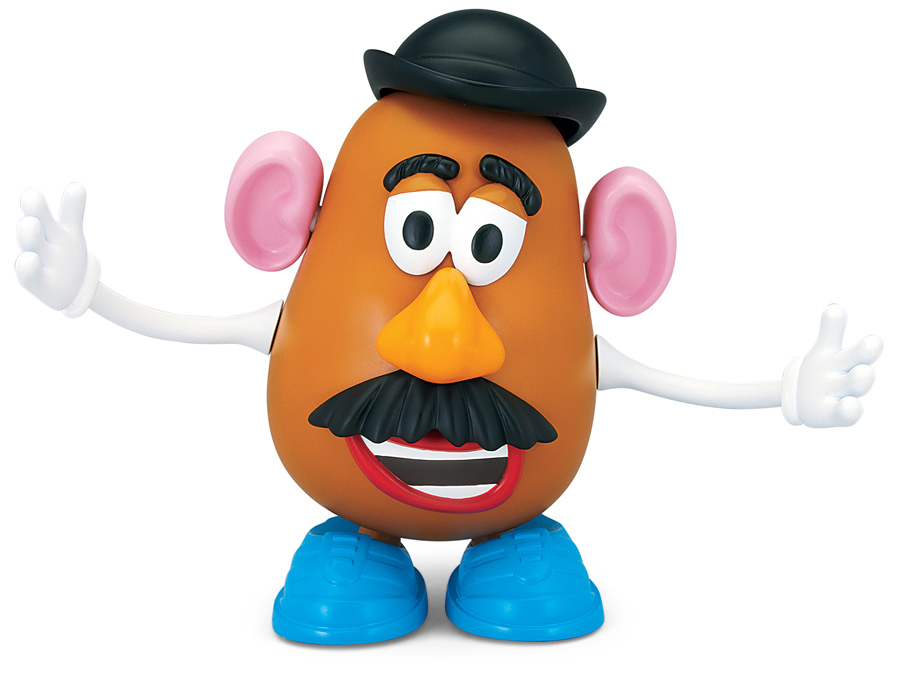
Karen from Cinnamon Brow CE talked with us about her work using Mr Potato Head to reinforce familiar language on parts of the body. The activities were obviously transferable and at this point teachers who work alongside visiting teachers were animatedly jotting down ideas they could use to follow up or reinforce language learning. 
For example everyone loved the Mr Potato Head photo shoot that Karen had created (and one teacher said to me “I will get my children to do this”). 

They liked the use  of the same pictures for simple hide and reveal – not high tech but practical and hands on , using A4 envelopes to slowly reveal Mr Potato Head. Karen suggested that the children can play this again afterwards on  their own. Taking the familiar primary “hide and reveal” technique again , Karen shared how she would ask the children to anticipate what missing facial parts there may be on Mr Potato Head in each new game .Simple, effective and activities we could transfer from one  core focus to another and that encourage the participation of all children and understanding ways to make learning fun.

Everyone shares!

Then it was time for us all to share- something that they use in their everyday work as primary practitioners of foreign languages!


I love this photo of Ian and Emma deep in conversation. Emma is a French coordinator
and she was keen to learn as much as possible about E Twinning and next steps for her school!


Human sentences and position of adjectives

Christine from Westbrook Old Hall had taken the time to consider a sequence of five lessons on monsters she delivered in the Autumn term 2013 with Y6


The children in Year 6  revisited their prior knowledge of  body parts, number, colours from previous years in KS2 and discussed and demonstrated their understanding from Y5 of the position of adjectives after the noun .Her focus in Year 6 was to look at the position of adjectives such as grand and petit before the noun  and to encourage the children to speak and write accurately using their knowledge of adjectival agreement.  She used Singing French and the monster song to reinforce prior knowledge and to encourage performance. The children looked at the adjectives grand/petit and the position they appear in French sentences and worked out what was different here to adjectives of colour. 
Christine read Grand Monstre Vert with the children and they investigated  the position of the adjectives in the sentences .


They  played human sentence games ordering 
the words in  French human sentences.The slide  shows how she used a ppt slide to first ask the children to create verbally sentences in French from an English stimulus and then revealed the sentence written correctly on the monster slide.

At this point Emilie,our native speaker visiting teacher- formerly a secondary teacher tweeted ……….


Really nice to hear primary MFL teachers / assistants mentioning grammar & dictionary skills as part of their teaching #showtell

 Town investigations with young learners

Lis from St Ann’s CE and Mandy from Stockton Heath CP talked about the town and how they created their two sequences of lessons based on shops in the town and directions.
What was fascinating was how both of them identified key points to consider – very practical primary points. They considered the experience, maturity and age of their primary learners carefully as they planned the activities.

Firstly that the children need to be guided to think of names of shops as they automatically when talking about a town would say H+M, Tescos  etc and not butchers, cake shop , bakery. 
Lis spent time talking about the town her children know best – Warrington-and then guiding them to talk about the names of the types of shops they had mentioned. Mandy shared with them various maps of French towns and pictures of buildings you would find there so she could  then hold a discussion with the children about which shops they might need to ask for in French. 

Both Lis and Mandy reinforced the cultural differences – how in France you still go to the bakers, butchers etc. Simple discussion maybe... but really important in laying the foundations for future cultural understanding that bridges the gap between what the children have experienced and what we might want them to learn about. Both Lis and Mandy worked with the children on directions and developed physical activities – Lis had a human street and used follow me cards to create role plays. 


Mandy had the children moving to visuals around the room and then she generated with the children a class map and display of a French town. Each child was given a cut out character and had to write a sentence  to give directions to a partner on where to place the cut out character on the  display.


The ideas were simple, effective and   addressed familiar matters  and useful questions and answers laying  the foundations upon which to build more detailed role play and transactional conversations.


Activities which reinforce good practice and language skills

 Last but not least was Jayne @Dewsnip_Jayne, a visiting teacher for JLN. Jayne explained that she was a secondary languages teacher. However over the last three years working as part of the network in 5 primary schools she had found the freedom of the primary classroom a revelation! She has learned so much from her primary colleagues and the children about how children learn a primary foreign language. 

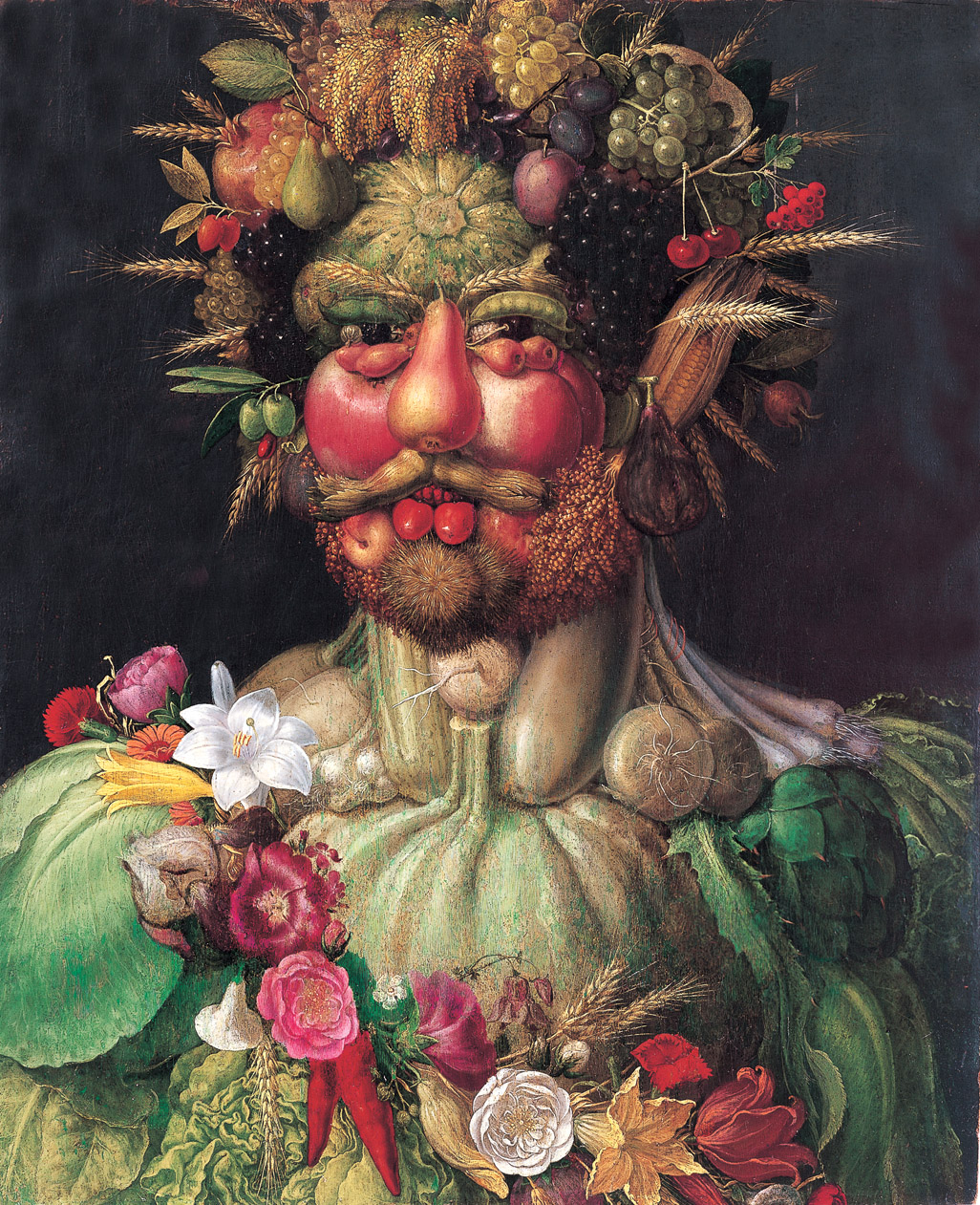
She shared with us her bilingual dictionary work based on Arcimboldo with UKS"2 children.


They investigated what the mystery letters after the words in the dictionary mean (m/f/pl/nm etc) so that they could create their own written and art posters of the Arcimboldo face(link to Jaynes arcimboldo pics) Jayne could see that this would help the children in KS3   language learning. 


Jayne shared her simple game “guess the combination” where from a table of 9 key words e.g. fruits the children guess the combination of three she has secretly written down . Jayne identified that she focused on accurate pronunciation and perhaps without realising this Jayne is once again encouraging good habits before KS3 .

Her puzzle game- simple cut up pictures is easy to replicate and use across all language areas. You need a minimum of two pictures from a core focus or a mixed focus , with a number and colour on the reverse .Children must ask politely for a number and a colour so that  a part  the puzzle can be revealed .Can the children guess and name the item correctly with the definite article or indefinite article?  

The final activity she shared was her work on adjectival agreement when describing a   male or a female and how easily she was able to reinforce this with her mother’s day flowers.  


Working in primary and developing creative primary approaches ,Jayne is reinforcing and encouraging good language skills and knowledge so that KS3 can build upon quality foundations laid in primary foreign language learning.


The overwhelming impression from this event is   that we are making  good  “practical primary progress”. It’s not rocket science and it’s not always all singing and dancing. My colleagues are developing a curriculum in their own schools that is fit for purpose.

In the range of presentations we heard about the four skills of listening, speaking, reading and writing and combinations of these skills to move the children on in their learning in every lesson and consolidate prior knowledge! We were asked to consider culture and links abroad and ways to link language learning to other subject areas in the primary curriculum and colleagues shared how they were encouraging the children to consider the structure and grammar of the language.


Wednesday, 23 April 2014

World Cup 2 Who is the person on the inside?


Take a look at the image! It's a football player .....but who is the person on the inside ?
These are World Cup activities for our Year 4 ,5 and 6 learners in the target language.

Yesterday thanks to @vallesco I received a link to the Daily Telegraph and the football strips for the World Cup teams.

Here's the link World Cup football strips

Here is the England team and their football strip ...........


......................................................................but what makes them who they are on the inside?  

Select some football strips of the World Cup teams! Give each table or group of six children a football strip and a country. 

Can the children investigate the countries and the famous buildings, foods,traditions and customs of the country and create a new football shirt of cultural graffiti for France .......


For Germany .......


For Spain...............


Here's my Spanish cultural graffiti shirt .I am certain our children will make them look far more authentic and creative!


The children can use this information to create an informative English presentation about the country and specific cultural aspects to share with the class with pictures etcetra.The t-shirt can act as their prompt as they hare their information with the class.
   

Now can they  create what's on the inside . Ask child in the group to select a team player from the World Cup team for the specific country and on the reverse side of the cultural graffiti shirt

Can they record on the reverse side of their shirt a target language greeting , a name phrase, maybe the town/city the player comes from and characteristics that describe the player (e.g. strong, quick,powerful,fast,brave etcetra)?

Here's my simple example:


Now the challenge is to create a football team of real people not just players . Each member of the team needs to introduce themselves and say their characteristics using the t-shirt as a prompt if necessary.

The class is almost ready for football team presentations . Each group must now decide upon a chant for their country name.

The final presentation will have three parts:

the country and the culture in English / the players and their characteristics in the target language / a final team line up and of course a team chant of the name of the country!  


Thanks to @vallesco for the French power point she has posted on light bulb languages to support teachers if they are investigating some of the participating teams in French and want to create their cultural graffiti t-shirts! French Who is inside the tshirt? ppt


World Cup Catch a Greeting Game KS1 and LKS2

This is my first blog post on the World Cup, which I hope will begin to support network teachers to develop activities to celebrate the World cup and to consider all the languages that will be heard at the global event.

The resources I refer to are all on JLN website.
You can take a look at the world cup resources we have created or sourced.

First let's celebrate the way the players and the fans will greet each other in all the various languages they speak.
Show your children this clip of 30 different ways to say hello from around the World


Now you can play "Catch a greeting!"


1.    Ask the children to recall as many different ways  of greeting each other both in their own home language , school language and in other languages they have seen on the video clip
2.  Practise the greetings they suggest.Practise the sound of the greeting. Ask the  children to think of the shape of the greeting both as a  sound they hear (is it wavy/sharp/spiky etc) and as written word.Ask the children to draw the greetings as sound shapes and then as the written shape in the air.

P
3.   Show the children some new greetings they haven't mentioned from the video clip.Look at the greeting word and the language it comes from and then practise the sound of the greeting on the sound slides that accompany each greeting.
4.    
5.   Give out small card versions of greetings from the video clip - one per child. Locate and listen to the greetings if necessary on the video clip
6. Ask the children to practise their specific greeting. Does it help them to draw the sound of the greeting or the shape of the word in the air?

7.  Ask the children to move around the room greeting each other and each time they greet someone they should swap greeting cards and therefore also the greeting word they have to say. Children should have the chance to say all the greetings.

Bring the children back together and each child a blank A4 piece of plain paper. Ask the children to investigate the flag of each of the country of the greeting card they are holding and to create a “Greetings “card to put on a class display.They should make sure that they spell their greeting accurately and make it an integral part of their flag.   

Why not share this song "Hello to all the children around the world " with your class as they create their flags for the display?