Sunday, 7 June 2015

Sunshine Sparklers !


This is my "sunshine sparkler" and here is a simple idea to use toward the end of the term with LKS2 emergent/ beginner target language writers!

The idea was inspired by this wonderful picture below of Versaille and its the illuminated fountains. I spotted it on Twitter


You can find out more about the fountains here on the le monde website

Firstly let's play simple games with "Summertime" words.
The following words immediately come to mind and you will probably be able to think of more!

picnic
sunshine
park
seaside
walk
swimming
holidays


  • Play familiar games like "Simon says " with an action for the words or charades and guessing the word as class mate has mimed or hunt thw word around the classroom or match the parts of words so that we can complete the word.Games that are class favourites fit here.
  • Then let's encourage children to look accurately at the words and write individual words high up in the air with their "sunshine sparkler" stick. Invisible but ,magical and everyone is taking part! and don't forget flicks and twists and wiggles for all those wonderful accents etc!
  • Each child could add their three top favouirte summertime words from the list to the sunshine symbol or start at the top of the sunshine sparkler sticks to take home too!
  • Can the children create their own "sparkling Versaille fountain style painted word art"" to add to a class display of "sunshine sparkling words.They could pick their favourite word from the list you have been playing games with and which they have written in the sky with the sunshine sparkler sticks. You could focus on the cursive writing of ther target language and ask the children to try to write the word in their word art in that cursive style !

French story books with purpose 2015!


Last month whilst in France I had a shopping list of books that I wanted to buy and spent a brilliant hour in Cultura in Carcassonne doing just that! 


The books I had on my list are to support and extend the work we already have organised in our SOW.


Here are the books and my reason for buying thjem:

Books that are linked to festivals and are also stories based on popular French story characters.
Our young learners like the idea that they are looking at books that real French children enjoy.So Tchoupi and Petit Ours Brun cam immediately to mind!

Birthdays: 

Christmas


Carnival 


Books that are educational books for French children that we can use to introduce or investigate a specific learning context that we cover.

The first two books I selected are for LKS2, short stories about visitrs to sepcific places.They are   inexpensive and again I chose two from the Petit Ours Brun series:


I found these three Kididoc books ( I love Kididoc) and feel that they can be used in UKS2 too as we can discuss how we can make books to help younger learners, focusing on the way the books inmtroduce language and use visuals , flaps etc.The books are also very informative and the text is accessible.With these books non specialist teachers can also  be creative aswell- I am thinking display made by the children etc.
I chose these three themes:

School for our Y5 school focus


The beach again for our Y5 focus


......and finally this Kididoc book caught my eye.We are extending our cross curricular work and here is a gift all about planet earth .Each double page spread is a different focus withon this context.Brilliant!


Our cross curricular focuses are already part of the network packages we create and whilst looking for stories within a series based on a fictional French character. I came across the character Barri and could not leave this book behind!It is beautiful .On each page it poses a question and then you need to lift the flowers or the pond or the grass flaps to see what mini beasts are hidden underneath! Fantastic.
Great for our KS1 mini beast focus and new resource for a theme we use each year plus what a great book to use with KS2  linked to DT and making lift the flap books for KS1 - or even a performance and use of questions and answers.


Last year I saw both of the following books but just didn't have room to bring them home! As I have just mentioned we are working in mofr detail on our cross curricular themes in the next couple of months I decided to hunt them out and bring them home! 

First a sophisticated look at travel to France by ferry- so UKS2 definitely!.Makes  lot of sense as so many of our children travel by ferry to France!  Several sentences per page , very detailed pictures to discuss what we can see in English and to look up key nouns in dictionaries etc and then to create our info docs!


And this wonderful book from larousse!" Le bord de mer" .It is a book to cherish I think .On some pages there are facts on others just pictures to discuss.There is a story that explains how to get to the seaide , pages on sea animals, rock pools ,under the sea, divers, keeping safe by the sea..... and  the list goes on.I love it!!


...And finally I wanted to find a book using instuctional text for Year 6 and our cafe culture theme! I found the most incredible recipe book which will be so easy to use in class because it is all about making sandwiches.
Double page spread, colour pictures and the most clear instructions and pictures! Great ideas that link to alsorts of themes too so you can use it with Y3,4,5 and down in KS1 too and not just in primary foreign language teaching either!




Summertime Special Days' Suitcases


Summertime is one of those wonderful themes that allows us to explore so much language with children :going to the beach , the countryside, picnics, playing outside at the park,a day at the zoo etcetra!  
I have used this opportunity to focus on:


Reading and looking for language we already know and investigating nouns and verbs as infinitives that we may not know


The use of the near future in a target language . In fact here is a question.... can our young learners define for us first of all how we pass on a message in English that is on the near future? In fact what is the "near future" and why is it so useful ? (I am going to .......)


It's a chance maybe as well to explore

  • bilingual dictionairies
  • paradigm of a common verb (to go)

And we can produce an outcome that shows how we have been practising reading comprehension skills.

The sequence of activities is based around three types of cards:

  • noun cards


  • near future verb sentence cards


  • short text cards using the verbal phrase "there is/are and nouns"


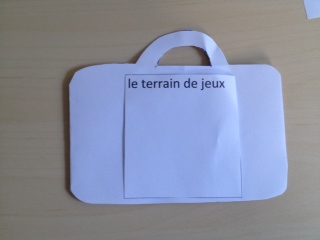
an empty cut out card suitcase template that opens up as a book.


Step One 

  • Decide upon your contexts.(I chose : the zoo, the playground, the picnic, the beach and the countryside)
  • Create your noun cards
  • Write the each noun that describes the context on a card.These are your "noun cards"
  • Write full sentences using the first person plural of the verb "to go" in the target language - so that you have written "Let's go + an activity that describes the noun and the context.I have tried to differentiate the challeng by writing some of these sentences with less familiar language than others.Write these sentences on individual cards - these are your "near future sentence cards"
  • Write out a short text using "there is/are" in the target language and selection of familoar and unfamiliar nouns of objects you may find , take or use in the specific context.These are your "short text cards".
  • You will need a set of cards per two children on the class
Step Two 

  • Ask the children to be explorers of "summertime special language".
  • Can the children working in pairs to look through the cards
  • Can they spot cards that just have "nouns" on them.
  • Ask the children to see iof they recognise these nouns or do they need to investigate them further using a bilingual dictionary?
  • Have a time limit to this activity and take feedback afterwards.What do the nouns mane in English? Does everyone agree?
  • Ask the children to see if they can sport the other cards in to two piles- don't give them any other information.Again set a time limit suitable to the class
  • Take feedback how have they sorted the cards? discuss why- e.g each card in one pile starts with the same two words (in this case nous allons...) or each of the cards starts with "il y a".
  • Discuss with the children the meaning of for example in French "nous allons" on the near future verb sentence cards
  • Discuss with the children the dual meaning in English of for example in French "il y a "( there is/are"). 
  • Ask the children to investigate the cards further and see if they can find out what the whole message on each card is telling them? Again set a time limit and allow them to use a bilingual dictionary and then take feedback.
  • Play games of charades or Simon Says based on the verbs and nouns they have explored and fed back to you.
Step Three
  • Can the children in pairs put the cards in to family groups ? They need a noun,a near future verb sentence and a short text card.The three cards shpuld make a complete descriptive text : noun (context) , near future verb card(what we are going to do etc) , short text card (what we take,eat,use etc)
  • Ask the children to share their decisions with a second group.
Step Four
  • Ask the children to make their summertime special suitcases.
  • Each child should make at least two suitcases
  • Now you have choices:
  1. Children can select and stick the cards on to their suitcase templates
  2. Children can write out the phrases using writing prompts that have parts of the sentence removed
  3. Children can try to write their own sentences from memory based on the cards they have been investigating
The front of the suitcase conveys the context


The inside of the suitcase tells us what we are going to do and some more details about the activity


And finally - don't forget the all important pictures on the reverse of the suitcase...to share with us the possible activities we can take part in based on the text the children have investigated!


Thursday, 4 June 2015

It's not rocket science! Implementation of primary language learning


"It's not rocket science!" This seems like such a great phrase to describe effective implementation of primary language learning in an individual school.

This afternoon I have been reviewing progress in one of our network schools during "one to one" consultancy time as part of the JLN membership entitlement.Find out more here.
Janet Lloyd Network Membership

The JLN member school subject coordinator asked me to go in and spend 2 hours reviewing what the school has achieved and where the school is going to next with language learning.

The local school has implemented effective language teaching and is now ready to take on the challenge of assessment and tracking progress.

Here are the ingredients that have been built up,over time and are helping the school to be effective in French language learning so far:

  1. Networking,sharing,learning
  2. SLT and governor support
  3. Appointment of a subject coordinator
  4. Receive training on the DFE POS and use this as sign posts to aid implementation 
  5. Using subject coordinator tools to guide and inform next steps 
  6. Effective language teaching and learning
  7. Progression across KS2
  8. Links with literacy and creativity
  9. Whole school buy in
  10. Subject coordinator and experienced French language teacher working together
  11. Celebrating language learning with display and events
  12. Keeping a record of achievements
  13. Using AfL to inform next steps
  14. Trialling tracking and assessment
  15. Considering how to implement tracking and assessment
The school has 


  • Has a comprehensive SOW in place.This school is loosely following our JLN SOW.Take a look here 


  • Is a member of an active and focussed network. The school belongs to our network in the North West.Take a look here  Janet Lloyd Network
  • Does listen and draw upon others ideas and experiences.
  • Receives virtual support , blog posts and Network News which keep this coordinator up to date. Take a look here.Network News
  • The subject coordinator works alongside the PPA French teacher and also delivers his own French language lessons , helping him to keep up to speed with the progress and the challenges of implementation.
  • Encourages members of staff to be aware of their own class progress in the language, using the tools and resources that accompany the subject coordinator's pack.(The school does not overburden staff)
  • Is building year on year on effective and successful practise and is moving towards more adventurous ways of approaching the language , for example with our "Blogs to go" or "APPS to go" SOW overlays.
  • Has built a  substantial resource bank of stories that allow for creative exploration of the SOW content. Take a look here at these two examples of support: Reading in the target language is great  New Spanish books and reasons why I selected them
  • Has display created by the children in the school to promote their language learning

 Today at school during our "one to one consultancy time" (part of the membership entitlement) we considered 

  • the progress and next steps of the school and the coordination of language learning using the Primary Self Audit Tools.
  • identified the "establishing tracking and assessment" area as the next step area for the coordinator and the PPA teacher 
  • considered how the JLN SOW tracking sheets can enable the whole school/ staff to have an awareness of content , transactional language progress and skill development.

The one to one time with the subject coordinator allowed 

  • the opportunity to dig deeper and understand what progress will look like across stages of learning and how to quantify the skill development
  • the opportunity to look at other network school approaches and find the best fit for this school and its current language learning foot print.
  • the opportunity to decide what will be the French teacher, the subject coordinator's and the class teacher's roles in the roll out of tracking and assessment next year
You see it isn't rocket science ,it's just sensibly paced and supported primary appropriate next steps........


Tuesday, 2 June 2015

Seaside Sequencing Story.Languages and Literacy


In sharing this animated sequencing story, I have to thank several people! 
Firstly Ana Lavado Garcia for her drawings and the original story power points some of us have used as part of the resources for JLN member schools.Secondly Ana and Emilie Woodruffe for their native speaker voices and time to put together authentic language in the simple story .Thirdly Little Red Languages for their work alongside WTSA/JLN to bring the "Alien family at the Seaside " story to animated life!


We love our extra terrestrial family and their adventures.
This year as part of our third local network meeting for the DFE funded WTSA/JLN language project "Language Learning for Everyone " we met the family at carnival for our "Carnival Triarama Conversations


Thanks to all the wonderful people above we are able to share this animated sequencing story about the seaside with you all.We hope you will enjoy exploring the story with your children in French and/or Spanish the following DFE KS2 POS learning objectives


DFE POS LOS: 

  • listen attentively to spoken language
  • speak in sentences,using familar vocabulary,phrases and basic language structures 
  • read carefully and show understanding of words, phrases and simple writing
  • appreciate stories ...in the language
  • broaden their vocabulary and develop their ability to understand new words
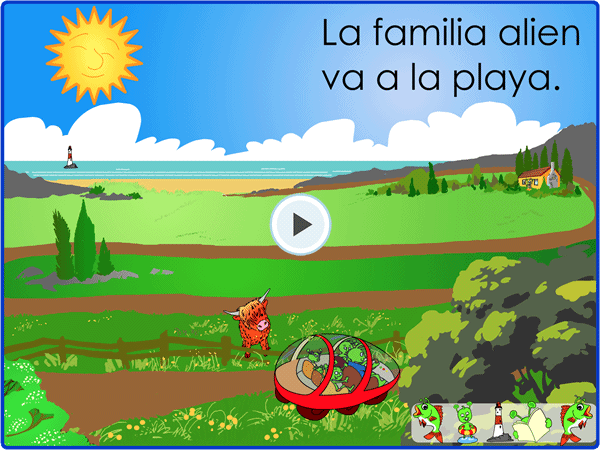
So here is the story - a short sentence or two per page with animations and sound files.
Take a look......


Thanks to Little Red Languages - you can pause the script, conceal the script, replay the sound file , go forwards , go backwards and watch the characters appear on the screen!

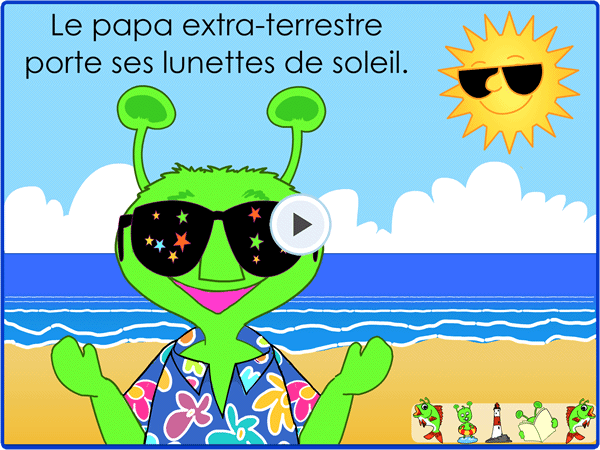
Spot the "space " theme throughout the pictures ( starry glasses, planet ice creams ,rocket sandcastle etcetra....thanks Ana!)"

Ways I would use the story file!
(Well it links so well with story telling in Literacy to be truthful!)

  • Share the front page and look for cognates in the story title.
  • Brainstorm words we may already know about the seaside and might expect to find in the story.
  • Categorise the words- nouns, adjectives, verbs, masculine/ feminine etcetra.
  • Encourage the children to look up words they really hope are in the seaside story.

  • Explore the instuctions on the second page and look up the key words forst in the bilingual dictionaries before actially clicking in the icons to see what they do and therefore understand the instructions 
  • Discuss and identify which words are adjectives, nouns and parts of verbs.

  • Listen to the story all the way through with the text and add actions for each page on a second hearing.

  • Listen to the story to explore the text on each page- show the text on each page, pause on key words, hide the text , practise as a class re-telling the story orally trying to be as exact and true to pronunciation as possible.
  • Explore replacement words and phrases- can we change the weather for example or describe dad's sunglasses or baby's enormous ice cream in more detail?

  • Spot the sequencing words.
  • Discuss the role of the sequencing words in the text.
  • Give out strips of card with the sentences written on the cards
  • Can the children in pairs put the story back together in order.
  • Listen to the text but this time conceal the words- can the pairs wave the correct sentence strip to match the sentence they hear?
  • Ask the children to rewrite the text in the order they want it to happen - moving the sequencing words around and therefore changing the order.

Of course as you may know I love drama - so.....
  • Let's learn the text and let's act it out 
  • Let's change the text and tell the story as a performance
  • Let's draw our own story and add our own sentences and sound files! 

We really hope you enjoy using this story and are able to join us next term if you are in the North West for one of our Local Network Meetings.
More details here


Going to the Seaside and exploring DFE POS Learning Objectives

We have had the brilliant fortune over the last year to work with WTSA to develop a DFE funded project to support teachers as they get to grips with the DFE POS and the learning objectives of the KS2 PoS.

Each term we have hosted and led a series of local network meetings around the designated NW area and had as a core theme "seasonal content" for whichwe have created packages of learning linked to the DFE POS Learning Objectives.If you are a teacher in the North West then you would be very welcome at our LNMs next term (Autumn 2015).The dates of the twilight meetings held in local schools during the first half term will appear here DFE Training Schedule


This term our theme has been "Going to the Seaside" .We try to share ideas that are suitable for beginners ,moving on and mofre advanced learneres.I have tried this year to share these ideas with a wider audience through my blog posts.The ideas and activities are intended to  help primary and secondary teachers understand more about the approaches and types of activites which will support progress in primary language learning 
Here are some of the activities "going to the Seaside" activities and the DFE POS Learning Objectives I think you can try to explore in more detail through the activities:

DFE POS LO: Explore the patterns and sounds of words


Seashell sounds and sand treasure hunts
(Thanks to Jo Shore for the pictures from her network meeting that she leads in Mid Cheshire.Brilliant!)


Fishing for letter strings and sounds
(Jo added additional ideas of her own with this game.I love this as it is about networking, growing and sharing etc)


DFE POS LO:Broaden their vocabulary and develop their ability to understand new words
DFE POS LO:Understanding basic grammar


Sandcastle Sentence Building


Jo tried it out in Italian too!


You may also like the following activities too:

DFE POS LO: Speaking and writing in full sentences


Under the sea triarama for speaking,writing and a puppet show


DFE POS LO:Describe people,places,things orally and in writing


Seaside geography comparison,verbs and sentence structure
An interesting way to not only look at the seaside and language about the  seaside but also to compare two towns not far from each other- one is French (Biarritz) and one is Spanish (San Sebastian) 


Now it's over to you!
How do you want to use these activities in your work around the theme of "Going to the Seaside"?
Or maybe... how do you want to to take the idea and change it to fit different content and contexts, but still explore the specific learning objective with your language learners?

Going back, to get to the future!

Strange title I know - "going back,to get to the future" but this is a possible learning opportunity with Year 6 during this final Summer half term !

I am very excited about the work some of my colleagues will be undertaking this half term with their Year 6 language learners! 


Some of my local colleagues have decided this half term to work with their Year 6 classes to explore other target languages - 

  • to excite and enthuse  Year 6 learners with a new language 
  • to see how language learning skills  are transferable and can help access a new language
  • to help our young language learners realise that they are now ready for secondary school and KS3 language learning and maybe a new language challenge!
  • to encourage our young learners as they leave primary to see that they are at the start of a very exciting language learning journey not necessarily stuck in one foreign language!


Take a look at this message from our Janet Lloyd Network Facebook page from @Deprezprez on 31 May this year !

Looking forward to starting to teach Spanish to my Year 6s at Burtonwood CP and Locking Stumps CP this half-term after many years learning French!! Will be a great challenge for them and interest after the SATs come down!


In my opinion learning a language involves risk taking and involves the transfer of both prior learning and skills.
We all need to be able to make mistakes and feel that we can try again and certainly be able to overcome the feeling that if it's not perfect use of language then there is no communication! 
Primary language learners need to be able to take risks, make mistakes,have another go and try to improve!


The experiment is a sort of "blast from the past" for myself really!
In  1995 I began working as a primary languages teacher with Year 6 children in a local primary school.The children were in a feeder school to a language college where half the children would learn French and half the children would learn German in KS3 Y7. I decided to teach half a term of French followed by half a term of German througout the school academic year.The same content and activities were used in both  half terms but in alternate languages.So many of the children thought German was more fun and that it was easier and at first as a Germanist I was very excited about this .I had obviously created lots of "German" language  enthusiasts...then I realised what was actually happening.The young language learners were relaxed during the second half term as we re-applied skills and participated in  very similar activities from the first half term.  In my opinion they were relaxed and learned effectively because they had already practised the language learning skills in French!


Let's go back to when I started teaching in 1985... maybe a similar thing was happening there too? 
Our "top sets" learned a second foreign language and were called the "accelerated language learning group" because they started their second foreign language in their third year at high school.
"Mmm?"I ask myself as I look back , maybe other children could have achieved this too? Should we have identified more clearly the skills that we were practising with all our language learners? Just a thought!


And if we go right back in to my past..... why am I a Germanist? Well,I learned French as my first foreign language alongside Latin and then two years later- German. I thought I was better at German- but was I? 
Maybe I  applied skills effectively that I had already practised in French and this helped me to access German more quickly (memory,recall, listening,speaking, reading aloud confidently,using a bilingual dctionary etc)?  This was probably on reflection proven at University ,but I didn't realise this at the time.It was expected that we studied Dutch or Swedish for two years whilst studying German and within those two years we  reached A Level standard in the language. I love drama and reading texts such as  Miss Julie by Strindberg in Swedish was a delight and that has always stayed with me! Did I realise at the time that I was using transferable skills?

It seems to me that skills help make you more confident to try to communicate in another language.In the last couple of years I have had to begin to understand and communicate at a limited level in Spanish and I find my understanding of the transferable language learning skills so useful and so powerful! 

And why do I believe that this is for more then just the "linguistically" able?Well the truth is that I am a "trained" not "true" linguist!
Yes I love languages and exploring languages and helping others to do the same! 
My first love is being able to communicate and be creative with language and text! 
On reflection I have become very adept at transfering skills and analysing language and looking for grammatical and structural patterns.


So this half term is maybe less of a great experiment and more of a great celebration! 

The Year 6 learners are about to start the next stage in their great  language learning adventure. We hope our activities this half term will help our young learners see the links between languages and how the mystery of language learning, isn't really an unsolvable mystery and that language learning skills and tools are transferable life long powerful assets!

The experiment does demand that the children trust us,are confident and excited about exploring a new language/culture and  want to see how the practise of language learning skills during their primary career can be used to access language a new language.

Skills? Well ....here are a few for starters!

  • listening and responding in a new language
  • looking and listening for similarities between languages to aid comprehension, 
  • knowing how to listen to and practise the sounds of the new language
  • accessing bilingual dictionaries to find the words to aid comprehesnion and comminication
  • trying to accurately copy the sound and the spelling of new language
It also demands that the teacher is confident enough in some cases to say "I am the facilitator" not the expert- let's explore this new language together.Let's consider the skills and tools we have been developing and let's step out in to a new language and see if we can communicate at a simple level in this language". Life skills I think that could be invaluable to all concerned! 

Who knows what language someone may need to understand or speak during the course of their own lifetimes!