Showing posts with label dance. Show all posts

Thursday, 3 September 2015

Let the Maori Masks Speak!


The Rugby World Cup starts on 18 September and as Warrington is just down the road from Manchester, one of the cities hosting matches for the competition, it is a brilliant opportunity to celebrate the sport and languages. 
For European Day of Languages (the week after the start of the Rugby World Cup) this year our theme is "Faces tell a story" and that's why I have specifically singled out "Maori Masks"as a starting point.

Take a look at the mask - just what is the mask telling us?


I selected this mask because of the markings and the shape. I wanted a mask that was long and almost oval like a rugby ball and I wanted a mask that had markings which could be seen as pencil or pen marks or brush strokes.

We can explore commands linked to physical and sporting actions and create Maori masks that speak for us.

Before you start:Set the scene
Discuss with the children the game of rugby and the physical actions that take place on the pitch (throwing a ball, catching a ball, sliding across the ground, tackling,lifting up players, jumping over ,scoring a try).
Note down the verbs as you discuss or share these .Can the children identify these words as parts of verbs? Can the children help you to make commands of these words in English?

Step One 
In the target language explore using physical actions and the key commands,the sound of the words, the action associated to commands and the shape you may make to complete the action,using commands such as:

throw/catch/jump/bend/run/lift/score/slide

Step Two
  1. Working with a partner,ask the children to create one flowing physical sequence of movements, using ansd saying the target language commands you have practised.
  2. The children could add the use of percussion instruments to represent the physical movements too. (I can think of colleagues I work with , who would develop this activity further and create dance sequences using the target language, the movements and percussion instruments).
  3. There is an opportunity here for volunteers to share their sequences with the class.  


Step Three
  1. Share with the children the Maori Mask picture.
  2. Explain that the masks tell a story and pass on a message.
  3. Share with the children some simple pencil or felt tip markings on a paper oval face shape of your own.These markings must represnet two or three of the commands you have practised with the children .Can the children guess which command each marking represents? 
  4. For example you may have a swirly marking with an arrow upwards to represent "lift"  or an exclamation mark to represenet "score " etc.

Step Four
  1. Give out pencils or felt tips and A4 card.
  2. Ask the children to draw a large oval shape on the card.
  3. Can the children design their own Maori masks with markings in pencil of felt tip that convey the sound of the words, the action associated to commands and the shape you may make to complete the action that you have been exploring.

Before the children add the actual written word, can another child in the class look at the mask and from the pencil markings identify which command each marking represents?

Now ask the children to add the letters of each command in a different coloured pen along the marking they have selected for the actual command.

One more possible step :A Group Command Haka Performance


  • Create simple masks of the card oval Maori mask drawings.
  • Can the children in groups of six create a sequence of movements using spoken target language words,where each child individually says and acts out their commands as they have explored and drawn them?
  • The children can decide whether one group member is in charge of percussion instruments too!
  • Children can perform these "command hakas" for the class or for a class assembly. 


Wednesday, 14 January 2015

Getting ready for carnival,being creative and exploring a story based upon le carnaval des animaux

Every year we love carnival! Last year we celebrated with a theme based upon:


"carnaval des animaux-camille st saens"


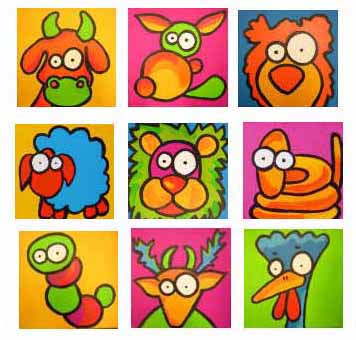
The theme linked so well with our Y3 focus on animals and teachers found ways to create masks, perform dances linked to the music and to investigate Art and DT - all based on this theme.Truthfully this was a theme and a focus that whole schools took as an opportunity to use as creative shared learning across Music,Dance.Art,DT and Language Learning

We were able too to look at nouns in the singular and plural , to investigate unfamiliar animal nouns using bi-lingual dictionaries and to generate simple question and answer role-plays about animals and descriptions of animals: "What is it? What colour is it? how many can you see? Do you like.....? "
(Teachers decided upon the most appropriate questions and answers for their learners and the prior knowledge of the learners).

i knew about this book "Au carnaval des animaux" by Marianne Dubuc based upon the music by Saint saens and so as a carnival activity, mask making and fancy dress followed quite easily.The book is available in several languages.
We used the book in French and Spanish:


The blog link here gives you a flavour of the book in French Litterature de jeunesse .Simple repetitive story which allows the children to invent their own animal characters. We used  simple cut out cards such as these below, to create our own fantastical fancy dress animal costumes and the cards where ideal for simple "Guess who I am ?" games- where one child holds a card and the other children /or another child has to guess which animals are on the card the first child is holding.


Leads to the children being able to make up the most amazing animal names - combining all the names of the animals they have know in one fancy dress mixed up animal written or spoken description.

And hot off the press just found this brilliant primary unit of work guide for a whole unit of work based around la danse des animaux- useful if you are a French speaker! 
Brilliant ideas

And don't forget the possibilities of a wonderful dance to this famous song! Le livre de la jungle!


Here are some ways that we have in the past developed very simple beginners language learning based on carnival celebrations and the story of au carnaval des animaux  

Tuesday, 20 May 2014

Brasil ,Celebrating the World Cup with a twist!

This afternoon was a wonderful afternoon and to be truthful it always is! I am meet with the language teachers who work with me in 31 schools on a regular all year weekly basis. It's our half termly training session.They bring their news and success stories and we discuss ways to develop and enhance the next half term's work over KS1 and KS2!  

Today the  planning focus was  the final half term during this Summer term 2014 and the language learning that will take place.


What a final Summer half term 2014 with the World Cup, the Tour de France  and the Commonwealth Games  already offering us wonderful ways to celebrate the diversity of languages and the sense of a global community through sport !


We also want to encourage the children to think about the diversity in local languages as we live so near to Wales, Ireland, the Isle of Man and only a couple of hours from Scotland. Some of the resources sourced for the Commonwealth Games  will allow the teachers the opportunity to listen to and practise languages that are spoken a matter of miles from where we live (15 miles to be exact from Warrington is the Welsh border) and one of the colleagues who attends the training today speaks Welsh! Indeed as we sat and discussed languages from quite near to us (and explained to our target language native speakers what we meant by "Manx"), it dawned on us that as many of us are local north-western people, our heritage and ancestry is tied up with these local languages!Many of our children and families will be able to trace their roots too in this way ... so what a great way to track all the children's family trees of languages too!


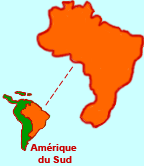
I think it’s also important that we look not just at the World Cup as a sporting occasion but as a chance to throw the spotlight on Brazil itself and celebrate culture and the environment in the target languages.We deliver currently French, German and Spanish.

So let's open the doors on Brazil !   


 Set the scene with music !


The sound and traditional children’s music of Brazi!

Here are short beautifully sung sound files which you could use to introduce the flavour of Brazil to your classes. Just to listen to and enjoy and maybe to vote on which is the class favourite!


Listen and join in with the French versions of the Brazilian children’s songs that you can hear first in Portugese on the wonderful Mama Lisa site 


Take a look at the geography and climate of the continent !

Learn some facts from Enchanted Learning Brasil page
Find out too from them about the Rainforest habitat and vegetation


Let the children read along with you this wonderful French story  where they can investigate and learn about the animals from Brazil in this wonderful repetitive story based on a toucan finding out who else is awake in the jungle 


Below is a clip in French, created for children in France to give them a taste of the tropical rain forests of the continent . The French is far too hard for young children but the ambience it creates – to just watch and see visual clues with the French commentary , adds a certain je ne sais quoi! 


In Year 4 Summer 1 with JLN SOW  we become jungle explorers...


So, here is a chance to revisit those jungle explorer rhymes and to create a Rainforest display filled with target language animal caligrams and shape sentences to describe the animals!Here is a display from a Bradford school to inspire us!


Learn some basic Brazilian Portugese ! 

Don't forget to learn a little language on the way! This Brazilian Portugese Omniglot webpage may help!


Daily life for children in Brazil


Using this marvellous site 24heures vie de enfant we can explore with the children the everyday life of a young child in Brazil through pictures and puzzling out of facts. Take a look here 


Let's celebrate, samba style! 

Finally when we think of Brazil we think of carnival and sambas , dancing and music and here I have found on the website Momes ,a Brazilian crown headdress which will leads us very nicely into the world Cup itself!


My suggestion is that we find out the names of  the countries that will be participating in the World Cup in the target language studied and select 12 feathers for our headdress.Each of the feathers created as  “paper feathers “ are made up of the flag and the name of participating country in the target language we are learning.Here are the French instructions on how to make a Brazilian crown 

Now we are ready for own samba style crown parade!
The dance class here for children could help your class to do this dance with proper samba style.