Monday, 2 November 2015

Art and a World of words


What  a simple but wonderful book! this link gives you more information about the book Art A World of words
On each double page spread you can find:

  • right hand page has a piece of famous art
  • left hand page has specific noun,adjective or verb linked to the picture - for example a picture of a lady on a swing (famous 18th century Art) and the 12 verbs for "to swing" with phonetic pronunciation below each verb.
So how am I thinking of using this book as a stimulus in language learning

  1.  For the understanding of basic grammar and vocabulary building
  2. To look at similarities and differences in languages and build inquisitive young language learners
  3. For performance
  4. For our own Art work
  5. To bring the picture to life with the use of APPs.
  6. To create our own word lists and creative activities linked to a famous picture.


Grammar and vocabulary 

  • Let's identify the artist and look at the picture on its own
  • Now let's discuss what we can see.Brainstorm key language or look it up in bilingual dictionaries
  • Let's identify the focus noun or adjective or verb we think the author of the book has identified in each picture.Ask the children to suggest verbs that link to the picture or nouns or adjectives that are associated with the pictrue
  • Now reveal the noun,verb, adjective that the author has chosen to link to the picture.
  • Create a "word doodle " ( drawing in the shape of the key word in the style of the picture and the artist)
A world of words and grammar.
  • Take a word walk through the key focus piece of vocabulary chosen by the author of the book to link to the picture.
  • Discuss the similarities and differences between the 12 wrds
  • Look for similartities across the languages or slight changes in letters or letter strings
  • Discuss the grammar links across the selected nouns (e.g the fact that masculine and feminine definite articles could look the same in different languages or that infinitives of verbs have similar endings etc)
Word Doodle Art
  • Picking up the idea of "word doodles" in "Grammar and Vocabulary" and linking this to the exploration of similarities and differences in languages mentioned in "A world of words and grammar" we can create "Word Doodle Art "of the picture
  • Take the shape, style and colours of the pucture and encourage the children to make word doodles with each of the 12 words to represent the word in each language in the style of the picture.Encourage children who have a home language to add their own key language too!
  • Create a class display.
Performance Time
  • This will be a very simple voice percussion activity either based on the one target language and the key vocabulary or exploring the possible sound of each of the 12 words in the different languages.
  • Ask the children to explore the phonetical spelling , to create the sound they expect for the word and then to perform the word in the style of the picture.Waht type of vpoice,speed and volume does the picture encourage you to use for the key word?
  • Put the spoken words of all the class together abnd make a class spoken orchestra of all the children speaking at the same time.
  • Record this.
  • Now take a photo of the picture.
  • Add a QR or use the Yakit4Kids APP and the sound file you have created and bring the pucture to life!
  • Play the APP for ther class!

Our own 5 little word books and our own short film of famous Art
  • Give out to the class the same piece of famous Art by a target language artist.
  • Find out more about the artist
  • Discuss the picture
  • Give out bilingual dictionaries
  • Challenge the children to identify and then find a noun, two verbs and two adjectives
  • Each 'child must write out the words, identify which structure within a sentence the word represents
  • Each child can then add spoken words using the APPs mentioned previously
  • Now share the pictures on the class IWB and watch and listen to the results!


Monday, 12 October 2015

Writing an Autumn Poem- Leaf Style!


This writing activity is based upon encouraging the children to use the language they already have learnt and to create their own poems about Autumn
The poems need to sound like an"Autumn walk"
It's an activity that all stages of learners can do as it relies upon recall and use of language they already know.
All you need are six leaf shapes.


The children should work in groups of four or with more advanced learners in pairs.
No poem will be the same in the class! 

You will need: 
Each group needs six leaves- numbered 1- 6 .
Each leaf shape  has a number on it.
Each leaf shape has an instruction written on the reverse side.

Writing a poem game- leaf style!

  • Spread out the six leaf shapes number side up
  • Roll the dice!
  • Select the leaf with the number on that is shown on the dice.
  • Turn the leaf over and create the line of the poem, according to the instruction on the reverse of the leaf shape.
  • Once the line is written, the leaf must be placed back on the table number side up and can be selected again if that number is the one that appears when the dice is rolled.
  • Each team or pair's poem will have atleast six lines as each numbered leaf must be used atleast once.
  • You could make this a time trial too - where the first pair or group to use up each of the numbered leaf shapes and completes their written poem are the winners.
What's on the reverse of the leaves as instructions?
Well there are prompts on the reverse of the leaves: 

1= nouns we know
2= adjectives we know
3 = a sequence of numbers we know
4= a sequence of colours we know
5 = instructions or commands we know
6 =an opinion word or phrase we know.

Let the children be creative.remind them that their poems need to sound like autumn walks- crisp, crunchy,snappy ,swirly etc
Can the children use their target language nowledge, repeat key words etc in the lines of their poems to create the atmospheric feeling of an Autumn walk


e.g.in its simplest form.................

Chien, chien , oiseau!
Grand,petit,gros! 
Trois, six, neuf
Noir,marron, orange!
Ecoutez! Regardez! Marchez!
Excellent, excellent,excellent!

A bit of performance and a bit of technology!
And of course if you know me well , then I would want to encourage the choldren to perform their poems and even record their poems as speaking leaves using an APP or a QR!


Thursday, 8 October 2015

Creating Characters and being Junior Judges on Strictly!


I love Strictly! We have used Stictly before in our network - a couple of schools created dance routines with directons, counting and commands.It worked really well.

Joanne, my associate colleague set up a Stictly Come Dancing Judges panel with numbers and personal info introductions too!

This year I am certain that children would love to become target language "Junior Judges"- just like the ones on the real programme.Watching "Strictly It Takes Two" I realised how we couod easily use this idea with children talking in the target language.

We will practise the verb "to be" and nouns.Add interesting adjectives and we could make similes too!
It's a simple but topical way of creating descriptive sentences, practising the verb to be and looking up and using nouns too and writimg,reading and saying out loud sentences in the target language!Oh and don't forget the children in the class will have to listen to each other too!


The tools we will need to be junior judges!

  • We need to consider which parts of the paradigm we will need to describe pictures of dancers.  
  • Firstly we need to practise the verb "to be" and selecting and placing the correct parts of the paradigm of the verb "to be" under dancers pictures "he...."/"she......"/ "they (male)......" they (female)....." and "they (male and female).......
  • Secondly we need to investigate nouns we may like to use to describe dancers and the characters they are portraying.Let's collect useful nouns  from our bilingual dictionaries: ( pirate/ princess/ fairy/wizard/cyclist/penguin/bear/gentleman/ lady/ fruit seller etc).I would show the children some clips of the dancing from Strictly come Dancing or you could show picures on screen of soke of the dancers in outfits etc- Movie night or Halloween night would be two good themes.There are plenty of pictures out there on the internet too to use...... 
  • Now let's play Simon says with the nouns and add actions and freeze frames

Judge the dancers!

  • Why not show the children a couple of the dancers and the dances and let the children write out a descriptive sentences about the characters in the dances e.g "He is like a pirate" or "They are like monsters" etc
  • Why not additionally or alternatively make it a guessing game.One person reads out the sentences he/she has written and the  rest of the class must guess who the sentences desctribes from the people in the show.
People Pillar Poems
You could always finish off the activity by creating some of my People Pillar Poems- using the characters from the dances....as both a writing and 3D display activity.Thanks to Clare Seccombe for the template!
Take a look here 


Spider's web.Reading and Writing Creative Game


On a walk the other day a good friend of mine took this fabulous photo. We saw this web and we knew it was a spider in the middle but look carefully and you could ask yourself ....."Is it a spider , is it a tiger....?" The colourings and the dew mislead you! 

As it is Autumn and some of us will also be looking for ideas for Halloween ,I thought this idea would fit well with writing in UKS2 in the target language.It makes a great guessing game and an interactive reading display too!

  1. Show them the picture and ask them which animals they can see.
  2. Ask the children to think of imaginary spider's webs and mystical powers.Ask them to look up in their bilingual dictionaries possible animals and adjectives such as colours and shapes to describe them.
  3. Ask the children to note down their findings.
  4. Brainstorm other possible animals that you might see in an imaginary spider's web
  5. Discuss the possible colours , size and shape of the animals
  6. Note down the language you discuss on the whiteboard
  7. ask the children to write three inetersting setences about the animal that they want caught in the spider's web 
  8. Ask the children to draw a spider's web.Can they then write their sentences clearly and carefully long the threads of their webs.
  9. In the centre they need to create their spider.Under the spider will be a picture of their own animal that they have described.
  10. To create their spider they must fold a piece of paper in two and on the outside flap draw the spider.Cut out the shape of the spider.It must be a size that can sit in the centre of the web the child has drawn.
  11. Now the child should add on the inside of the folded paper a drawing of the imaginary animal that is described in the written sentences. 
  12. The folded spider flap needs to be added to the web
  13. Each child is now a spider's web creator and must find partners in the class to work with
  14. The partners in the class must read the sentences, draw on a mini whiteboard what they expect to see caught in the spider's web.Then the partner can lift the flap of the spider picture in the cnetre of the web and see if the drawing matches the original drawing of the spider's web creator?
  15. The children swap roles and the reading activity starts again.
  16. The children can swap partners several times and once you collect in the webs you have a wonderful display! 


Mille feuilles moments!


Inspired by the Great British Bake Off  yesterday evening I realised what great fun we could have with writing in the target language - creating our own mille feuilles ! 

It is such a simple idea and would work with children writing at different stages in their language learning and although it is very much a French cake , I can't see why we couldn't use this in other target languages too!


  • Each layer in our mille feuilles will be a layer of paper.
  • Each piece of paper will have some special writing upon it .
  • Each layer of filling will be the additional information we want to add.
  • The icing decoration on top will be the "Word Art" depiction of the writing we have done throughout our layers- it will give our readers a  taste - a clue to what they are about to read!
  • As with all good cakes the proof is in the eating! So we are going to let our class friends read our writing and decide if the word art gave us the correct clue to the writing


How will this actually work?  

  1. Identify the content you want the children to write about- personal information, likes and dislikes, family , the weather, animals etc.(Simple familiar content for beginners...perhaps more challenging content with more advanced learners)
  2. Brainstorm key language with the children
  3. Give each child five strips of paper or ask the children to cut paper to the correct size to make a mille feuille cake.Show the children what one of these cakes looks like.
I have selected two current focuses from our own VLE and SOW 


Beginners: Simple Colour Cakes
Now we are ready to make our cakes.Our cakes are going to be about colours.

Bottom layer - a strip of paper.Write our first sentences -a sentence to tell someone a colour we like.
Filling layer- second strip of paper- a pictionary of items in the colour we have just written about.
Third layer - new strip of paper- a sentence about a colour we don't like.
Filling layer- a pictionary of items in the colour we have just written about
Top layer- our Word Art decoration- just how are we going to add our icing and decorate the top of the cake so that our readers have an idea about the messages we are giving when they geing to read the cake and deconstruct the cake layer by layer?!

Moving On: Autumn Cake Walk Poems 
This is going to be an Autumn poem using commands, counting and colours.
Bottom layer - a strip of paper.Write our first sentence: a command, colours and numbers to set us on our walk.
Filling - a strip of paper that has simple sentences about leaves we find on our walk
Third layer -a new command, colours and numbers to continue on our walk.
Filling - a strip of paper that has simple sentences about animals we find on our walk
Top layer our Word Art depiction of our poem and the type of walk our readers are going to go on, when they start to deconstruct the cake and read the information!

Wednesday, 30 September 2015

Autumn activities


Over the last two years and at this particular time of year, I have written blog posts to celebrate Autumn.I  have brought them altogether here to help those who want to teach a series of lessons based on Autumn.


Simple activities that all your staff can use to practise numbers , colours,simple language with an Autumn style theme, based around leaves, counting and the colour of leaves.


Being creative with the theme of autumn from creating imaginary fantatsical fruits to creating our own German Eulen and reading a Spanish Autumn poem


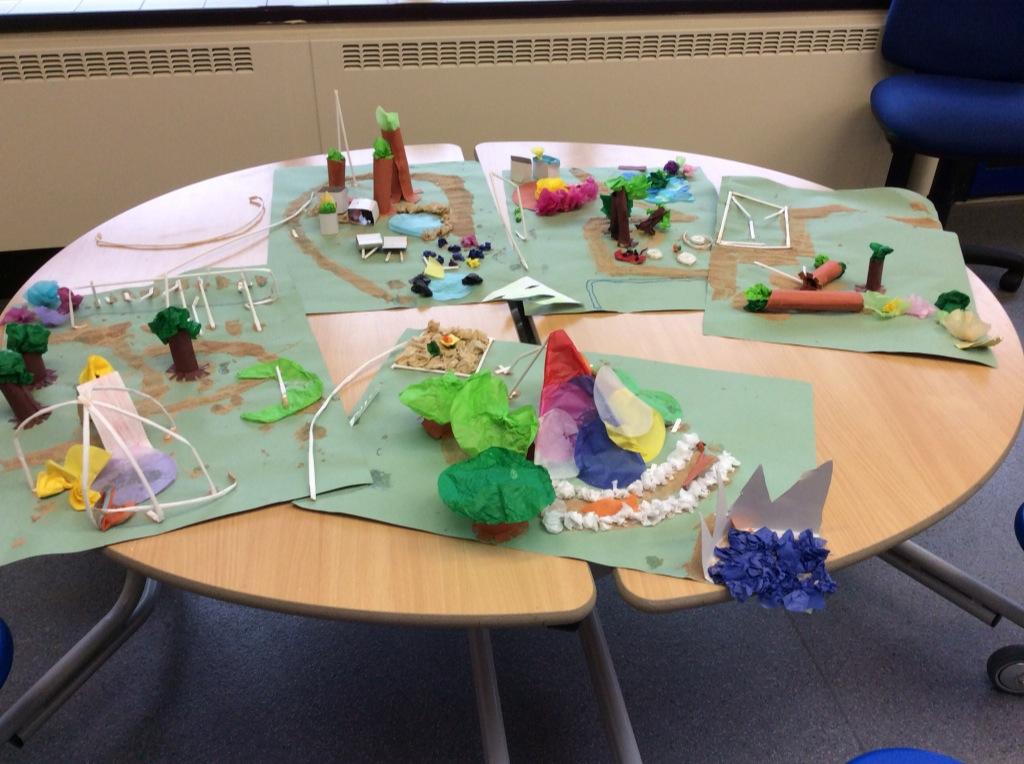
Taking an Autumn walk, making 3D maps of parks and places in town


Exploring a beautiful French poem with UKS2 - les feuilles mortes.


Writing ,and a review of this half term's language learning, using Autumn leaves to be gathered in amd shared out again at the start of next half term!


Autumn markets and simple language links with Maths.


Using drama,poetry,music and performance to go on an autumn walk with a French poem


Looking for nouns, adjectives and verbs


Autumn sentence trees.Writing complex sentences (noun,verb, adjective, conjunction and intensifier)


Tuesday, 29 September 2015

Superhero language skills,messages and an AfL postbox

With Year 3,some of our network using our SOW will be looking at "superheroes" and how to introduce ourselves as "superheroes".
Joanne Hornby did some fabulous work on this last year in Spanish with her beginner language leaners. 
Not long ago I put together People Pillar Portrait Poems as an opportunity to describe superheores etc
Look what I found yesterday in Dunelm Mill- whilst actually looking for new pillows!
 It gave me an idea! Why not create Superhero AfL boxes! A really simple idea but could be very effective and an idea that could run through the year. 


Superhero communication powers
  • Discuss superhero "powers " with the class
  • Talk about how some superheroes can have super powers of communication 
  • Suggest that the language learning taking place in your class is allowing your young learners to develop the superhero power of communication.Some of your class may already have these super powers! (Think about your learners working with EAL)
  • Talk about the powers of memory , recognition , listening and reading comprehension, pronunciation, writing in a target language.


  • Share with the class your super hero powers' box.This is a blank box and it needs decorating.It needs a postbox opening on it and a lid that can lift off - or you can use one like the box I found in Dunelm Mill!  The children are going to help you decorate the box.They need to take one of the superhero communication powers and make a symbol for this super power.All they need to do is to glue their symbol to the box!
Creating the AfL superhero ,message strips 
  • Create with the class superhero pictures - small drawn pictures of the face or figure of their favourite superheroes -one per child with their favourite superhero on the photo and a target language greeting written in a speech bubble next to the character.
  • They need to add the target language name phrase for themselves under the picture.You could let the  children to add a superhero surname too e.g je m'appelle Madie Smith Catwoman"

  • Collect in  the drawings. Glue each drawing to the left hand side of A4 paper.One picture below another. You will now have a left hand side list of pictures.
  • Now you can now keep these sheets to  create superhero message strips when needed.One per child when you want the children to think about which "super powers of communication that they are getting better at and which super power they feel they still need to improve.
  • Each child is given a strip of paper with their own picture and phrase on it.They are going bto write their message back to you on this strip of paper and post it in the super power box.
  • Discuss with the children what types of language super powers you are developing with the class at the moment - remembering(memory), saying  accurately (pronunciation),reading carefully (recognising),etc
  • Can the children on their individual strips of paper write a super power message to you about what a language learning skill(super power) they think they are developing well and a language learning skill (super power) from your list that they want to get better at.
  • All they have to do is date the strip of paper and post it in your super hero box when they have finished.
  • You can look at the strips of paper as a class and ask a child to share what helps them have a  "good" super power in a skill or you can look at the strips away from the class and see what your next steps as the teacher should be.
  • The super power message strips can be glued in individual record books at a later date too as an informal skills progress record